

Yasumoto Kajihara — Calligraphy “On the Making of Tea”
Yasumoto Kajihara — Calligraphy “On the Making of Tea”
Price on request
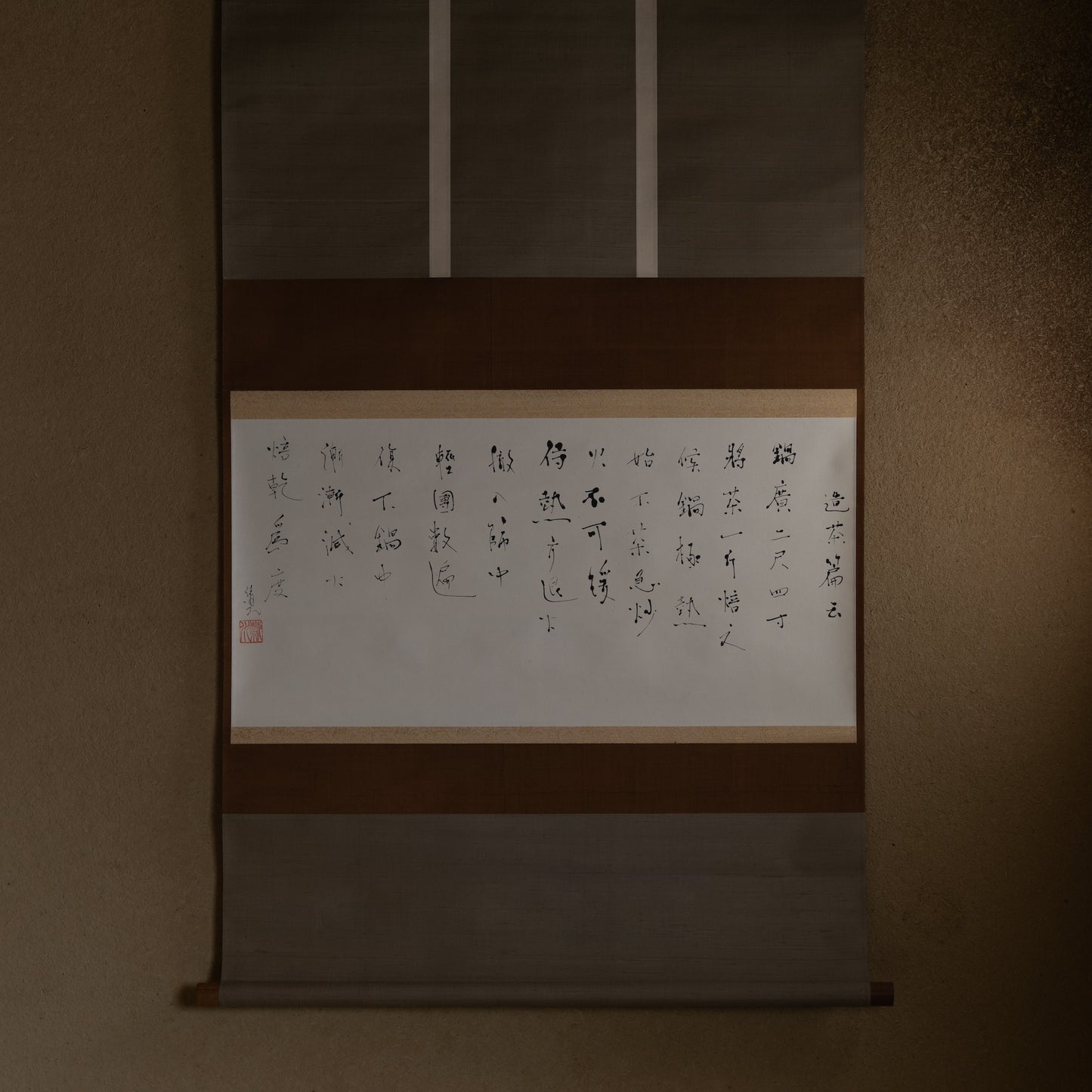
A calligraphic work by Yasumoto Kajiwara of Karatsu. Mounted as a horizontal hanging scroll.
《造茶篇云 鍋廣二尺四寸 將茶一斤焙之 候鍋極熱 始下茶急炒 火不可緩 待熟方退火 徹入篩中 輕團數遍 復下鍋中 漸漸減火 焙乾爲度》
The passage is excerpted from “Chajing Caiyao” (“Essential Extracts from the Classic of Tea”), in Volume 14 of the Wanbao Quanshu, compiled by Mao Huanwen during the Qianlong era of the Qing dynasty and cited in the original notes to the tea text Dongdasong by the Korean Seon monk Choui.
It describes both the virtues of tea and the essential principles of handling it:
“The section on making tea says: use a pan measuring two chi and four cun across and roast one jin of freshly picked tea leaves. Heat the pan thoroughly before adding the leaves, then stir-fry them quickly without allowing the fire to weaken. Once the leaves are sufficiently heated, remove them from the fire, transfer them to a sieve and gently roll them several times. Return them to the pan, gradually reduce the heat, and continue until they are fully dried.”
This passage comes from the original commentary on the lines “中有玄微妙難顕 真精莫教軆神分” in Dongdasong. It is closely related to another work by Kajiwara, Kokuu Zanmaite, which draws on a nearby passage from the same textual tradition. In these works, Kajiwara reorganizes and selects phrases found in “Chajing Caiyao” and in later texts that transmitted it, including Chashinden and Dongdasong.
What is written here is an exceptionally concrete account of tea production: heating the pan, roasting the leaves, rolling them, returning them to the fire, then gradually lowering the heat until they are dry.
Yet this is not a mechanical process. It requires observation—watching the leaves closely, judging their condition, and intervening in response to each change. Rather than mastering nature from outside, it is a way of spending time “being-with” it. In this respect, it has much in common with Kajiwara’s own work with the anagama kiln.
It also resembles the procedures of chanoyu, in which a place and an occasion gradually come into being through a prescribed sequence of bodily movements. This is more than an efficient method of production: matter, body, and time enter into a particular order, and only through that order does something emerge. In this sense, the description of tea-making has an almost ritualistic quality, even something of the cadence of an incantation. Through fire, it also forms a connection between chanoyu and ceramics.
The main text of Dongdasong speaks in abstract terms such as “玄微” (the subtle and profound), “妙” (the wondrous), and “真精” (true essence). Yet the commentary placed beside those words gives us thoroughly material instructions for working with fire and tea leaves. The mysterious does not exist somewhere beyond material practice; rather, it emerges from within it. This paradox is part of the fascination of the work.
Mounting by Matsui Shoten|Inner border: tea-colored shike silk|Ichimonji: white-ground Wakuda kinran brocade|Upper and lower sections: rusted pale-blue-green shike silk
69 × 120 cm|Signed wooden box and tatō storage wrapper
Material: Washi paper, sumi ink
Country of origin: Japan
Condition: New / Unused
Ref. YKB13
Couldn't load pickup availability
RETURNS ARE NOT ACCEPTED UNLESS THE ITEM ARRIVES DAMAGED OR DEFECTIVE.
Prices do not include VAT or import duties.Any applicable taxes are assessed upon import and are the responsibility of the buyer.
International Shipping
International Shipping
International shipping is available primarily by EMS (Express Mail Service). Orders to the United States are currently shipped by DHL Express.
All international shipments include careful packing, tracking, and compensation or insurance coverage where applicable.
[Important Note on Duties & Taxes]
Customs duties, import taxes, customs clearance fees, carrier fees, and other local charges are NOT INCLUDED in the item price or shipping cost unless explicitly stated otherwise, and are the responsibility of the recipient.
For orders to the United States, DHL may contact the recipient by email or SMS to collect applicable duties, taxes, and clearance-related fees before delivery.
Large works, multiple-item orders, or works requiring special packing may require an individual shipping quotation.
For more information, please see our Shipping Policy.
About the photographs
About the photographs
Photographs are taken in natural light.
Depending on your screen and viewing environment,
colors may appear slightly different from the actual piece.
Each work is made by hand, and variations in glaze and surface
are inherent to the process.
Differences in color or appearance arising from these conditions
are not considered defects and are not eligible for return or exchange.
In the case of significant discrepancy from the description, please contact us.